Entrepreneurship
The Next Accelerator Might Look Like a Media Company
By Hedi Mesme ·
Updated
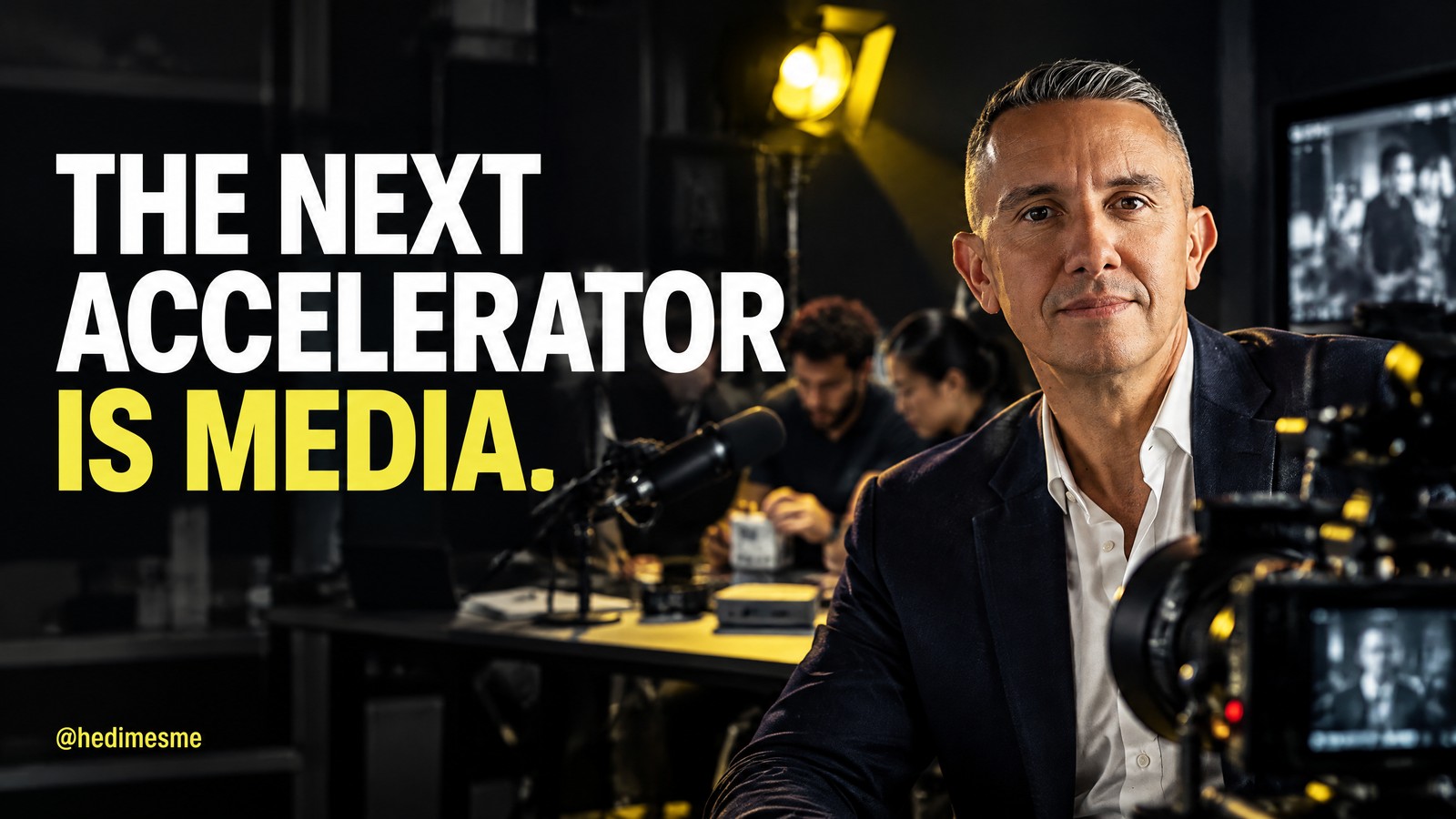
A media-native accelerator should build a business and its route to market together. The test is what customers still choose to pay for when the cameras stop.
Real venture building, not a talent show.
A media-native accelerator would build a company and its route to market together: use media to reach relevant buyers, then judge progress by customer evidence, paid delivery and repeat business—not views. It would need independent operating and investment decisions so that a compelling episode never substitutes for a viable business.
Key takeaways
- Build the product, customer understanding and distribution together instead of treating marketing as a final step.
- Separate audience attention from buying intent; test value through paid delivery and repeat use.
- Protect commercial judgment and privacy with distinct editorial, operating and investment decision rights.
An accelerator can produce an excellent demo day and still leave a founder with no repeatable way to acquire a customer.
The deck is clear. The product works. The pitch gets applause. Then the founder goes back to the same unanswered question: who will buy this, and how do we reach them again?
That is the weakness I want to challenge. Not the existence of accelerators. The separation between building a business and building its route to market.
My argument is to combine entertainment, entrepreneurs, capital, technology and distribution into a business-building engine. A model worth exploring for 2027 could look less like an accelerator with a camera attached and more like a media company with a serious venture-building discipline inside it.
Dubai could be a candidate, but its suitability would need to be tested.
The distinction matters. A startup talent show produces a story about entrepreneurs. A media-native venture builder would need to produce businesses that survive without the story.
Build the business and its route to market together
In the ordinary accelerator sequence, founders build largely in private, prepare a polished explanation, then ask the market for attention. Distribution becomes a task to solve after the product is ready.
I would reverse that separation, not abandon product development.
The proposed system would test the customer, the narrative and the channel alongside the product. Which problem makes a specific buyer stop and listen? Which explanation produces a useful conversation? Which channel reaches people with the need, authority and budget to act?
Those questions should influence what gets built. They should not merely influence the launch video.
Technology would help teams prototype, deliver and measure. Capital would support disciplined experiments and operations. Entertainment would make the process understandable enough to attract participation. Distribution would connect it to potential buyers, partners and talent.
Each part would have a job. If entertainment cannot lead to commercially useful contact, it is a production expense. If technology cannot help deliver value, it is a demonstration. If capital only extends the filming schedule, it is financing the wrong outcome.
The camera is a channel, not the customer
A viewer may like the founder, enjoy the format or want to follow a difficult decision. None of those motives necessarily creates demand for the product.
That is not a criticism of viewers. They never agreed to become customers.
The system would need to distinguish attention from intention. A view shows that something was watched. An interview can reveal a problem. A paid test can reveal willingness to spend. Delivery can reveal whether the promise was credible. Repeat use can reveal whether the value lasted.
Even payment is not the end of the argument. A sympathetic audience can buy once to support a founder. A discounted test can conceal weak economics. A burst of demand can overwhelm delivery and damage trust.
The question is not whether a graph moved upwards. It is what moved it, what happened afterwards and whether the result can be repeated under realistic conditions.
A hypothetical founder, from audience to evidence
Consider an explicitly hypothetical founder building a service that helps small hospitality operators handle recurring supplier orders.
The first content would not declare the product revolutionary. It might explain a recognisable operational problem and invite operators dealing with it to speak privately. The audience is a starting point for discovery, not proof that a business exists.
The team would then interview relevant operators. Who places orders? Where do mistakes happen? What do those mistakes cost? What is already being used? Who could approve a paid test?
Some enthusiastic viewers might have no purchasing authority. Some operators might dislike the content but urgently need the service. The founder must be willing to prefer an unglamorous buyer conversation over a flattering comment section.
From those interviews, the team could define a narrow paid test: a specific ordering workflow, a limited scope, a clear price and an agreed delivery period. No vague promise to transform the whole operation.
The founder would deliver the service, perhaps manually at first, while recording the work required. Did it actually reduce the customer's burden? Did staff use it? How much support did it demand? Could the price cover a credible delivery model?
Then comes the less cinematic part: asking whether the customer wants to continue paying after the test ends. The team should investigate cancellations, repeat use and reasons for renewal, not just assemble testimonials.
A successful episode would not require a successful product. If the interviews reveal that the problem is too minor, the responsible decision may be to stop. If the service delivers value but cannot be delivered economically, the team has another problem to solve before scaling.
The content could explain the decision without exposing customer information. The business decision would remain accountable to evidence, not to the audience's preference for a happy ending.
Distribution must become an asset
Platform reach can create an opening. It cannot be treated as permanent infrastructure.
An account with a large audience is still exposed to changes in reach, rules and audience behaviour. A venture builder that depends entirely on one feed has a channel dependency, not a complete distribution system.
I would want the media activity to build assets the business can retain: permission-based customer relationships, consented contact records, useful research, a clear positioning, repeatable sales materials and direct commercial channels.
Ownership requires care. A subscriber to the programme has not automatically consented to marketing from every venture it features. An audience database should not become a pile of leads passed around without permission.
The test is what remains when an episode stops circulating. Can the team contact interested buyers appropriately? Can it explain its offer without the show's host? Can it acquire the next customer through a channel whose cost and performance it understands?
Reach opens the door. A business still needs a way to keep working when the platform stops holding it open.
Entertainment and operations need different scoreboards
The difficult part is not combining media and business in the same room. It is preventing one from corrupting the other.
Editorial teams need clarity, momentum and a reason for people to watch. Operators need accurate information, time to investigate and permission to make decisions that may be boring on screen.
A dramatic pivot may make good content and destroy a useful experiment. A charismatic founder may carry an episode while struggling to deliver. A quiet team may build a valuable business that is difficult to package.
I would give those teams separate scoreboards and explicit decision rights. Editorial performance could be judged on attention and quality of explanation. Venture performance would be judged on customer evidence, delivery, economics and progress against its actual constraints.
Neither scoreboard should be allowed to impersonate the other.
The operating team must be able to refuse a manufactured deadline, reject a misleading claim or continue a useful test after the storyline has moved on. Otherwise, the company becomes a prop in its own development process.
Some of the best work should stay off camera
Building in public does not mean making everything public.
Customer interviews, pricing negotiations, financial details, intellectual property and personal information may belong in private. Confidentiality is not an obstacle to authenticity. It is part of being a credible operator.
Participants would need informed consent, clear boundaries and a practical way to withdraw material that should not be broadcast. Sensitive discussions should not become public merely because a release form exists somewhere.
A founder should also be able to say, “We cannot share that yet,” without being punished by the format. Employees and customers should not have to trade privacy for access to the programme's resources.
The editorial opportunity is to explain the reasoning behind a decision, not to expose every document behind it. A useful account can show what changed, which assumptions were challenged and what the team will test next while protecting identities and commercially sensitive details.
If secrecy is always treated as suspicious, serious businesses will have good reasons to stay away.
Capital must keep its own judgment
The presence of investors could make this model more useful. It could also introduce the most damaging incentives.
A sponsor may want visibility. A producer may want a funding reveal. A founder may believe participation creates an entitlement to investment. Those expectations should be separated before filming begins.
There should be no on-air guaranteed funding and no suggestion that audience approval substitutes for investment judgment. An investment decision should follow an independent assessment of the business, its risks and its terms, with the freedom to decline regardless of editorial pressure.
Potential conflicts need explicit treatment: who owns what, who pays for exposure, who may invest, whether anyone receives referral compensation and how sponsorship influences selection or coverage.
A sponsor's commercial involvement should be disclosed, not hidden inside apparent advice. Founders should know whether a recommended service is an operating choice or a paid placement. Investors should not be presented as endorsing a venture merely because they appeared in the same episode.
Trust would depend less on the glamour of the people involved than on rules that still work when their interests diverge.
The real test starts after filming
Watching somebody sell is not the same as learning to sell. Nor does every failed experiment automatically produce useful learning.
A venture-building process should make participants do the work: prepare interviews, make offers, handle objections, negotiate scope, deliver and review what happened. The footage may help explain the process. It cannot perform it for them.
Learning becomes usable when the team records its assumptions, sets a meaningful test, interprets the result honestly and changes the next decision. A failure without that discipline can simply consume money and time.
That is the discipline behind better business reps: an attempt should produce observable feedback, a debrief and an informed next step, not just more footage or activity.
The durable output should therefore include more than episodes. It should include customer knowledge, operating routines, delivery systems, documented decisions and people capable of continuing the work.
Scaling would also require different questions from proving an initial sale. Can delivery remain reliable at greater volume? Does acquisition still make economic sense beyond the first audience? Is the team hiring to resolve a real bottleneck, or to maintain the appearance of momentum?
A sensible system would allow ventures to slow down, leave the format or close. Keeping every company alive for continuity would be an editorial choice disguised as a commercial strategy.
Dubai is a candidate, not a business model
My view is that Dubai could be a candidate for testing this approach because the proposed model depends on bringing entrepreneurs, capital, production capability and potential customers into a workable operating environment.
But that proposition needs validation, not repetition. Are the relevant buyers reachable? Can participating teams serve them legally and reliably? Does the production budget leave enough room for real venture work? Can the model attract operators as well as personalities?
Those questions matter more than a location announcement.
Dubai should not be used as an explanation for why something will succeed. The model would need competent execution, appropriate permissions, clear governance and a customer market that fits the ventures being built.
For 2027, I see a hypothesis worth testing, not an inevitable next chapter. The location could support the work. It could not rescue a format built around the wrong incentives.
Build something that does not need the show
I am interested in media-native venture building because attention could become part of a disciplined commercial process rather than something founders chase once everything else is finished.
But “media-native” must not become another label that conceals weak businesses behind strong production.
The standard should be demanding: use attention to reach relevant people, use conversations to define a real offer, use paid delivery to test value and use repeat business to challenge the original thesis. Keep editorial judgment, customer obligations and investment decisions distinct.
Then let the cameras tell a truthful story about the work, including the decisions not to continue.
If the cameras stopped tomorrow, what would remain that a customer would still choose to pay for?
Frequently asked questions
What is a media-native accelerator?
A media-native accelerator would develop a venture and its distribution together. Content would help reach potential customers, partners and talent, while the operating team tested the offer, delivered value and assessed whether the business could stand independently of the programme.
Does a large audience prove customer demand?
No. Views and engagement show attention, not necessarily buying intent. Relevant buyer conversations, paid tests, delivery outcomes and continued use provide different kinds of evidence; even an initial sale may reflect sympathy or a discount rather than durable demand.
How should a media-native venture builder measure progress?
It should use separate editorial and business measures. Media teams can assess attention and clarity of explanation; venture teams should assess customer evidence, delivery reliability, economics and repeatability. Investment decisions need their own independent assessment, and sensitive customer work should remain private.
References
- Related perspective: Hedi Mesme — entertainment-led venture building, distribution and a possible 2027 model. This is an author perspective, not evidence of an established programme or confirmed partnership.
Continue the conversation
What would your venture still own if its biggest source of attention disappeared? Explore more discussions in Medias, or consult the media kit for editorial context.